
Conquering the Clouds: Mastering Obstacle Avoidance with the DJI Agras T25 for High-Altitude Mountain Spraying
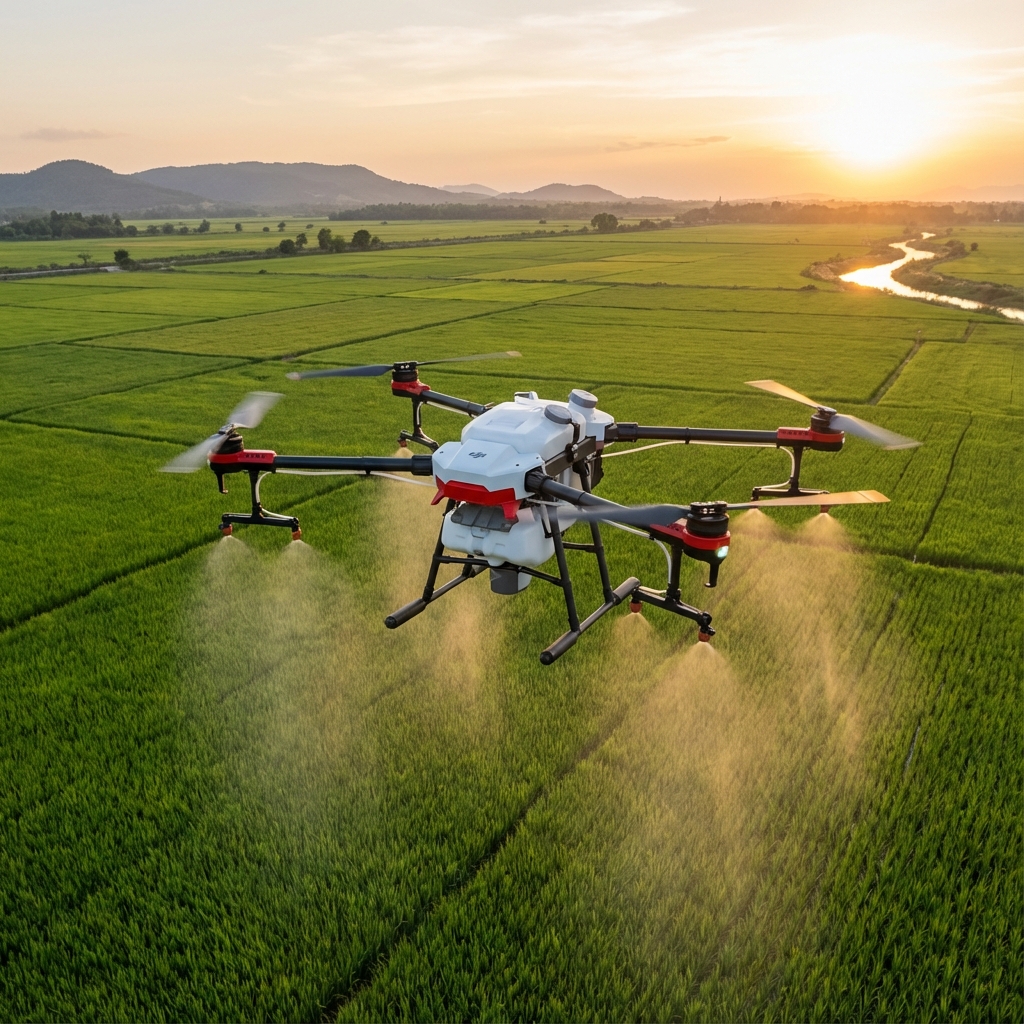
Conquering the Clouds: Mastering Obstacle Avoidance with the DJI Agras T25 for High-Altitude Mountain Spraying
TL;DR
- The Agras T25's omnidirectional obstacle avoidance system becomes your most critical safety net when operating at 3000m elevations, where thin air, unpredictable thermals, and rugged terrain create a uniquely hostile environment for precision agriculture.
- Achieving centimeter-level precision with RTK requires maintaining an RTK Fix rate above 95%, which demands strategic base station placement and understanding how mountain topography affects signal propagation.
- Antenna positioning on your remote controller is the single most overlooked factor in maintaining reliable transmission—keeping both antennas perpendicular to the aircraft's position (not pointed directly at it) can extend your effective range by up to 40% in mountainous terrain.
The morning mist clings to the terraced tea plantations of Yunnan Province as pilot Chen Wei powers up his Agras T25. At 3,200 meters above sea level, the air is thin enough that his lungs feel the strain—and so does every piece of equipment not engineered for this environment.
But Chen isn't worried. He's been running agricultural drone operations in these mountains for three seasons, and he's learned that success at altitude isn't about fighting the environment. It's about understanding it.
"Most pilots who fail up here make the same mistake," he tells me, adjusting his remote controller's antennas with practiced precision. "They treat mountain spraying like flatland work with a better view. The mountains will humble you fast if you think that way."
The Altitude Challenge: Why Mountain Spraying Demands Superior Obstacle Avoidance
Operating agricultural drones above 3,000 meters introduces a cascade of technical challenges that compound upon each other. The reduced air density—approximately 30% less than at sea level—directly impacts rotor efficiency, requiring the aircraft to work harder to maintain stable flight.
This is where the Agras T25's engineering philosophy proves its worth. With a 20L tank capacity optimized for the power-to-weight ratios demanded by high-altitude operations, the aircraft maintains the agility necessary for responsive obstacle avoidance even when fully loaded.
The Physics of Thin Air Flight
At altitude, three critical factors converge to make obstacle avoidance not just useful, but essential:
Reduced Lift Efficiency: The T25's propulsion system must generate more RPM to achieve equivalent lift, which affects stopping distance and maneuverability when the obstacle avoidance system triggers an emergency halt.
Thermal Instability: Mountain environments generate powerful updrafts and downdrafts as the sun heats rock faces unevenly. These invisible air currents can push an aircraft toward obstacles faster than a pilot can react.
Terrain Complexity: Unlike the predictable geometry of flatland agriculture, mountain farms feature irregular terraces, overhanging rock formations, power lines strung across valleys, and vegetation that changes height dramatically within meters.
Expert Insight: The Agras T25's spherical obstacle avoidance system uses a combination of binocular vision sensors and radar to create a protective envelope around the aircraft. At altitude, I recommend reducing your maximum flight speed by 15-20% from flatland settings. This gives the system additional reaction time to compensate for the reduced stopping power in thin air.
Decoding the Obstacle Avoidance Architecture
The T25 employs what I call a "defense in depth" approach to obstacle detection. Understanding each layer helps operators configure the system optimally for mountain conditions.
Sensor Suite Performance at Altitude
| Sensor Type | Effective Range | Altitude Impact | Mountain Optimization |
|---|---|---|---|
| Forward Binocular Vision | 1.5-40m | Minimal degradation | Increase sensitivity in low-contrast snow conditions |
| Backward Vision | 1.5-30m | Minimal degradation | Critical for terrace edge detection during turns |
| Horizontal Omnidirectional Radar | 1.5-30m | Stable performance | Essential for detecting wire obstacles |
| Downward ToF + Vision | 1-30m | Reduced accuracy in dust | Calibrate for rocky terrain reflectivity |
| Upward Radar | 1.5-15m | Stable performance | Vital for overhanging cliff detection |
The radar components maintain consistent performance regardless of altitude, making them particularly valuable in mountain operations where visual sensors may struggle with the high-contrast lighting conditions common at elevation.
The Antenna Secret: Maximizing Transmission in Mountain Valleys
Here's the field knowledge that separates experienced mountain operators from newcomers struggling with signal loss.
The DJI remote controller uses a dual-antenna MIMO transmission system. Most operators instinctively point these antennas directly at their aircraft, assuming this maximizes signal strength. This is incorrect.
The antennas radiate signal in a toroidal (donut-shaped) pattern. Maximum signal strength occurs when the flat face of each antenna is oriented toward the aircraft—meaning the antennas should be perpendicular to the aircraft's position, not pointed at it.
The Mountain Valley Protocol
When operating in valleys or on mountainsides, signal reflection and multipath interference become significant factors. I've developed a systematic approach:
Step 1: Position yourself so the aircraft operates within a 120-degree arc in front of your position whenever possible.
Step 2: Angle both antennas outward at approximately 45 degrees from vertical, creating a V-shape when viewed from behind.
Step 3: As the aircraft moves to the edges of your operational area, rotate your body to maintain the optimal antenna orientation rather than simply adjusting the sticks.
Step 4: If operating near rock faces or metal structures (common in mining-adjacent agricultural areas), position yourself so these reflective surfaces are behind you, not between you and the aircraft.
Pro Tip: I carry a small compass and note the magnetic bearing to my planned flight area before each mission. Mountain terrain makes it easy to become disoriented, and maintaining proper antenna orientation requires knowing exactly where your aircraft is operating relative to your position.
RTK Configuration for Centimeter-Level Precision on Slopes
Achieving reliable multispectral mapping and precise swath width control on mountain terrain requires RTK performance that many operators struggle to maintain. The key metric is your RTK Fix rate—the percentage of time your system maintains full centimeter-level precision rather than falling back to meter-level accuracy.
Base Station Placement Strategy
On flatland, base station placement is straightforward. In mountains, it becomes an art form.
The RTK base station requires clear sky visibility to maintain connections with positioning satellites. Mountain ridges, peaks, and even tall trees can create "shadow zones" where satellite signals are blocked.
Optimal placement criteria for mountain operations:
- Elevation advantage: Position the base station at the highest accessible point that still provides practical access
- Southern exposure (in the Northern Hemisphere): Satellites in geostationary orbits cluster toward the equator
- Minimum 15-degree clearance: Ensure no obstacles block the sky above 15 degrees from horizontal in any direction
- Stable mounting: Wind speeds increase with altitude; secure the base station against gusts that could shift its position mid-mission
Maintaining Fix Rate Above 95%
| RTK Status | Accuracy Level | Acceptable for Precision Spraying? |
|---|---|---|
| RTK Fix | 1-2 cm | Yes - Full precision operations |
| RTK Float | 20-50 cm | Marginal - Acceptable for broad coverage only |
| DGPS | 1-2 m | No - Pause operations and troubleshoot |
| GPS Only | 2-5 m | No - Risk of overlap gaps and spray drift issues |
When your RTK Fix rate drops below 95%, the practical impact on spray precision becomes measurable. Swath width consistency degrades, leading to either overlap (wasting product) or gaps (reducing efficacy).
Nozzle Calibration for Altitude-Adjusted Application
The reduced air density at 3,000+ meters affects spray drift patterns in ways that catch inexperienced operators off guard. Droplets travel farther before settling, and the thinner air provides less resistance to wind-induced drift.
Altitude Compensation Protocol
The Agras T25's 20L tank and variable-rate application system allow for precise adjustments, but the operator must understand the underlying physics.
Droplet size selection: Increase droplet size by one category compared to flatland recommendations. If your standard protocol calls for fine droplets, switch to medium. This reduces drift potential in the less-dense atmosphere.
Flight height adjustment: Reduce your spray height by 0.5-1 meter compared to equivalent flatland operations. The increased droplet travel distance at altitude means you can maintain coverage while flying closer to the canopy.
Speed compensation: The T25's obstacle avoidance system performs optimally when the aircraft maintains consistent speeds. Erratic speed changes—common when pilots manually compensate for wind gusts—can trigger unnecessary avoidance maneuvers. Trust the system and maintain steady velocity.
Common Pitfalls: What Mountain Operators Get Wrong
After three seasons of high-altitude operations and consulting with dozens of pilots across multiple mountain regions, I've catalogued the most frequent errors that compromise mission success.
Pitfall 1: Ignoring Thermal Timing
Mountain thermals follow predictable daily patterns. The two hours after sunrise and two hours before sunset offer the most stable air. Midday operations, when thermal activity peaks, dramatically increase the workload on obstacle avoidance systems as the aircraft constantly adjusts to turbulent air.
Pitfall 2: Underestimating Battery Performance
Lithium batteries deliver reduced capacity in cold mountain air. A battery rated for 10 minutes of flight time at sea level may provide only 7-8 minutes at 3,000 meters in cool morning conditions. Plan your missions with 30% additional battery reserve compared to flatland calculations.
Pitfall 3: Neglecting Pre-Flight Obstacle Mapping
The T25's obstacle avoidance system is reactive—it responds to obstacles as they're detected. Proactive operators walk their flight zones before the season begins, noting wire locations, tree heights, and terrain features. This information allows for route planning that minimizes obstacle encounters rather than relying solely on avoidance.
Pitfall 4: Improper IPX6K Rating Interpretation
The T25's IPX6K rating provides excellent protection against the sudden rain showers common in mountain environments. However, this rating assumes proper maintenance of seals and gaskets. At altitude, UV exposure is more intense, accelerating rubber degradation. Inspect and replace seals according to an accelerated schedule—every 75% of the manufacturer's recommended interval.
Pitfall 5: Single-Operator Mentality
Mountain operations benefit enormously from a two-person team. One operator focuses on flight control while the second monitors the aircraft visually, watching for obstacles the sensors might not detect (such as newly installed wires or wildlife).
Field-Tested Mission Planning Workflow
The following workflow has been refined through hundreds of mountain missions:
Pre-Season (One Month Before Operations)
- Physical survey of all planned flight zones
- Documentation of obstacle locations with GPS coordinates
- Base station site selection and access route planning
- Equipment inspection with altitude-specific focus on seals and batteries
Pre-Mission (Day Before)
- Weather analysis with emphasis on wind patterns and thermal forecasts
- RTK base station battery charging and verification
- Flight plan creation with obstacle waypoints marked
- Backup battery preparation with cold-weather considerations
Mission Day (Pre-Flight)
- Antenna orientation verification
- RTK Fix confirmation before takeoff
- Obstacle avoidance system test using manual approach to known obstacle
- Communication check between team members
During Flight
- Continuous RTK Fix rate monitoring
- Regular antenna orientation adjustment as aircraft position changes
- Thermal activity assessment every 15 minutes
- Battery temperature monitoring
Frequently Asked Questions
How does the Agras T25's obstacle avoidance perform when flying between narrow terrace rows common in mountain agriculture?
The T25's omnidirectional sensing creates a protective envelope that excels in confined spaces. For terrace operations with row widths under 5 meters, I recommend activating the "Terrain Follow" mode in conjunction with obstacle avoidance. This combination allows the aircraft to maintain consistent height above the sloped terrain while the horizontal sensors prevent contact with terrace walls. Reduce flight speed to 3-4 m/s in these conditions to give the system maximum reaction time.
What's the maximum wind speed for safe mountain operations with full obstacle avoidance functionality?
While the T25 is rated for operations in winds up to 8 m/s, mountain conditions require more conservative limits. Wind speed at altitude is typically 20-30% higher than readings taken at ground level. I recommend a personal operational limit of 6 m/s measured at launch altitude for precision spraying missions. Above this threshold, the aircraft's constant corrections to maintain position can interfere with spray pattern consistency and increase obstacle avoidance trigger frequency.
Can the obstacle avoidance system detect the thin support wires used in vineyard and orchard trellis systems?
The T25's radar-based detection is specifically designed to identify thin wire obstacles that challenge vision-based systems. Wires as thin as 5mm diameter can be reliably detected at ranges of 10-15 meters under optimal conditions. However, wet or icy wires may have reduced radar reflectivity. For operations in trellised crops, I recommend pre-mapping all wire locations and programming exclusion zones as a redundant safety measure. Contact our team for a consultation on optimizing obstacle avoidance settings for your specific crop infrastructure.
The sun is fully up now over Chen Wei's mountain operation. His Agras T25 moves methodically across the terraced slopes, its obstacle avoidance system quietly handling the complex geometry of ancient agricultural engineering meeting modern precision technology.
"The mountains don't care about your schedule or your equipment costs," Chen reflects as he monitors his RTK Fix rate—a solid 98% this morning. "But when you have a machine that's engineered for these conditions and you understand how to work with it, the mountains become just another workplace."
For operators ready to expand into high-altitude agricultural applications, the combination of the T25's robust obstacle avoidance architecture and proper operational protocols transforms challenging terrain into productive opportunity. The technology exists. The techniques are proven. The mountains are waiting.