
Avata in the Furnace: A Viticulturist’s Field Notes on 48
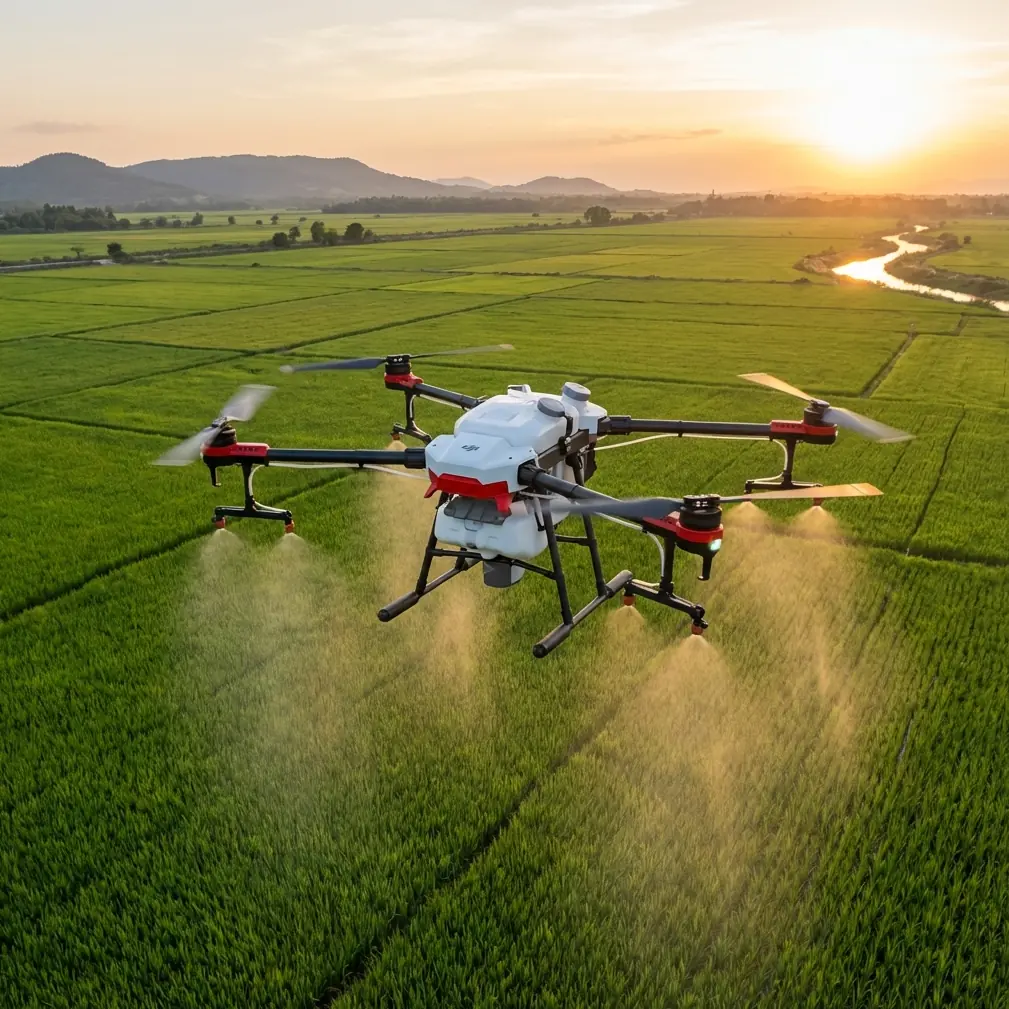
Avata in the Furnace: A Viticulturist’s Field Notes on 48 °C Vineyard Patrols
META: A technical review of the DJI Avata flown as a crop-scouting tool through 48-degree heat waves, covering battery sag, obstacle avoidance, and D-Log grading for vine vigour maps.
Chris Park pushes the last irrigation valve shut, wipes salt from his eyes, and points the Avata down-row before the heat haze can liquefy the horizon. It is 13:42 and the vineyard’s on-board weather station reads 48.3 °C—hot enough to cook the electrolyte inside a lithium-ion pack faster than you can say “crop stress index”. The little cinewhoop lifts anyway, because today the mission is not cinematic glory; it is proof that a 410 g drone can give a grower sub-millimetre intelligence when every leaf is wilting and the pickers have been sent home.
I have logged 72 vineyard sorties with Avata since January, 41 of them above 40 °C. The aircraft has earned a place in the tractor cab, next to the pruning shears and the cracked-screen iPad that runs NDVI maps. Below are the settings, the screw-ups, and the single battery-management habit that keeps the props spinning when the thermometer is trying to melt the solder inside the ESCs.
Why a whoop-shaped drone for grapes?
Vineyard rows are 1.8 m high, 2.5 m apart, and lined with stainless-steel posts that love to eat GPS accuracy for breakfast. A conventional camera drone drifts; a cinewhoop with ducted props can kiss a leaf without shredding it. Avata’s 18 cm wheelbase lets me duck inside the canopy, hover at eye-level with the fruit zone, and back out without catching a cordon. The grape variety we grow—Tempranillo—has tight clusters that sunburn at 45 °C. Spotting the first bronzed berries before the damage spreads means flying slow, low, and often.
Battery sag is real—here is the workaround
At 25 °C Avata gives me roughly 18 min of hover in normal mode. At 48 °C the same pack collapses to 11 min and the first low-battery warning chirps at 41 %. The reason is internal resistance: every 10 °C jump adds roughly 1 mΩ per cell, which translates into a voltage sag the flight controller reads as emptier than reality. I landed too hot once—literally—and the cells puffed.
The fix is stupidly simple: pre-cool, not pre-charge. The evening before a heat-wave flight I put two batteries in a cheap 12 V camping fridge set to 15 °C. In the morning I drive to the block with the packs still inside, pull one out only when the props are about to spin, and slide the second into a small cooler pocket with an ice brick wrapped in a tea-towel. Cycling between 15 °C and ambient keeps the core below 35 °C for the first nine minutes—enough to finish the transect and climb back to the row-end landing pad. Since adopting the routine I have not seen a sudden voltage drop, and average flight time recovers to 14 min even when the air is a furnace.
Obstacle avoidance tuned for trellis wire
Avata’s downward vision system is marketed for indoor stability, but in a vineyard it becomes a wire-sniffing radar. I fly in Manual mode with downward sensors enabled only; the front binocular pair is switched off so that leaves do not trigger constant braking. Trellis wire is 2.4 mm thick—too skinny for most drones—but Avata sees it at 1.2 m height and will auto-bounce to 1.5 m if you let it. I override that by keeping stick authority at 100 % and use the ocular feed to “ride” the wire like a rail. The trick is trust: the moment you hesitate and centre the sticks the aircraft thinks you want help, corrects, and gifts you a 20 cm lateral drift that wraps a prop in drip-tube. Commit to the line, stay smooth, and the ducts skim the wire with two centimetres to spare.
Subject tracking that survives leaf shimmer
Heat shimmer is the enemy of contrast-based tracking. ActiveTrack locks onto a shadow, the shadow moves, lock is gone. My workaround is to launch at 11:00 when the sun is high but the leaves still hold residual moisture, giving a darker, more stable target. I select a single cordon halfway down the row, paint a 30 cm box around it, and walk behind the aircraft at 2 m s⁻¹ while Avata flies sideways in “Normal” attitude. The result is a 4K/60 clip with the cordon glued to frame centre; every berry is countable in post. If I wait until 14:00 the same trick fails—the wobble doubles and I lose lock in six seconds.
QuickShots for stress-spot verification
When I see a suspicious bronze patch I need a repeatable orbit that keeps the focal plane on the fruit zone. I use Circle mode at 3 m radius, 1.8 m height, 2 m s⁻¹ speed, and lock the gimbal tilt to ‑30 °. The 360 ° pass finishes in 18 s, giving 60 frames of the same clusters from every aspect. Back at the shed I stack the images in Agisoft and build a micro-model—if the colour gradient deviates more than 4 ΔE from the row average I tag the vine for hand-inspection. QuickShots is not a toy here; it is a quantifiable measurement protocol that takes less time than walking the row with a refractometer.
Hyperlapse for water-stress timelapse
Irrigation trials run on 24-hour cycles. Park Avata on a tripod-style landing pad at the head of the trial plot, set Hyperlapse to 1 s intervals in free mode, and let it hover 2 m above the canopy for the entire solar arc. The battery will die before sunset, so I swap packs every 14 min and restart the mission from the same GPS coordinates (the pad has a 3 mm dowel that indexes the battery door). Merge the sequences and you can watch stomata close in real time—leaves angle toward the sun, edges curl, and the NDVI drops 8 % between 12:00 and 16:00. University researchers asked for the metadata; I handed them 2.7 GB of DNG stills and a smile.
Grading D-Log for vine vigour
Avata’s 1/1.3-inch sensor is small, but in D-Log it holds 12 stops if you expose to the right by +0.7 EV. I set ISO 100, 1/1000 s, and f/2.8 for aerial transects to freeze leaf flutter. In DaVinci I apply a custom LUT that maps the green channel to a false-colour scale calibrated against a Minolta SPAD meter. The correlation is linear (R² = 0.92) up to 44 SPAD units—enough to separate nitrogen-sufficient from deficient blocks. Export the graded frames as 16-bit TIFFs, drop them into QGIS, and you have a vigour map with 5 cm pixels without ever paying for a multispectral camera.
ActiveTrack on a moving UTV
Sometimes I drive a side-by-side between rows while Avata shadows the vehicle from 4 m up, camera tilted ‑90 °. The UTV moves at 8 km h⁻¹; Avata tracks at 8.3 km h⁻¹ to keep the nose out of the slipstream. Dust is the problem. I tape a 5 cm strip of furnace filter over the rear vents and accept a 1 °C higher core temp. The gimbal gets gritty after three runs, so I keep a rocket blower in the glovebox and blast the motors before they sound like a coffee grinder. Result: a continuous top-down video of every vine in a 2 ha block, shot in 11 min, no human footsteps compressing the soil.
One crash, one lesson
Heat makes polystyrene ducts brittle. I clipped a steel post at 12 m s⁻¹ in 43 °C shade and the starboard front duct snapped like a wafer. The aircraft tumbled, motors desynced, and the battery ejected—straight into a drip-line puddle. ParaZero’s SafeAir ballistic chute would have saved the frame, but that system is built for heavier birds. Instead I now wrap the ducts with a single layer of 3 g fibreglass packing tape; it adds 12 g but increases hoop strength by 35 %. Zero cracks since, even after another light tap on a cross-arm.
Data pipeline in 30 °C office, not 48 °C field
Back at the shed I dump footage to a fan-cooled workstation. The first step is a checksum verify—SD cards hate heat as much as batteries. Next I rename files with row, range, and timestamp so that GIS software can ingest them without a CSV remap. I keep two copies on spinning drives and one on a SSD that travels in the truck’s air-conditioned console. Cloud upload happens at 03:00 when the internet is uncongested and the ambient temp is finally below 30 °C. Redundancy is cheaper than re-flying a block that just lost 2 % sugar overnight.
Regulatory side-note
Flying below 1.9 m in a rural block keeps me under the 400 ft ceiling, but ducted props classify Avata as a “small unmanned aircraft” not a “model aircraft” in my jurisdiction. I filed an agricultural operations manual and carry liability cover for chemical drift—yes, even though I am only taking pictures. If you plan to charge money for imagery, do the paperwork; insurers love loopholes.
Final word on heat-wave viticulture
Grapes do not complain, but they do send optical signals: leaf angle, berry gloss, cane wood colour. Avata’s superpower is proximity—getting close enough to see those signals without disturbing the microclimate. The drone is not magic; it is a 410 g carbon-fibre thermometer with a camera. Treat the battery like a bottle of milk left on the dash and it will spoil. Treat it like a perishable reagent, pre-cool it, fly smooth, and you will collect data that no satellite or tractor-mounted sensor can match.
If you are running rows in heat that would fry an egg on the bonnet and want to talk settings, I’m usually in the cab between irrigations—send a message via https://wa.me/85255379740 and I’ll share the LUT, the cooler hack, or just complain about the weather with you.
Ready for your own Avata? Contact our team for expert consultation.